Marine waste is not merely an environmental pollution issue; it is also a critical challenge that the global industry must address as it transitions toward a circular economy. Transforming discarded marine materials into valuable resources that can be reused in manufacturing is essential to reducing waste and creating a more sustainable future.
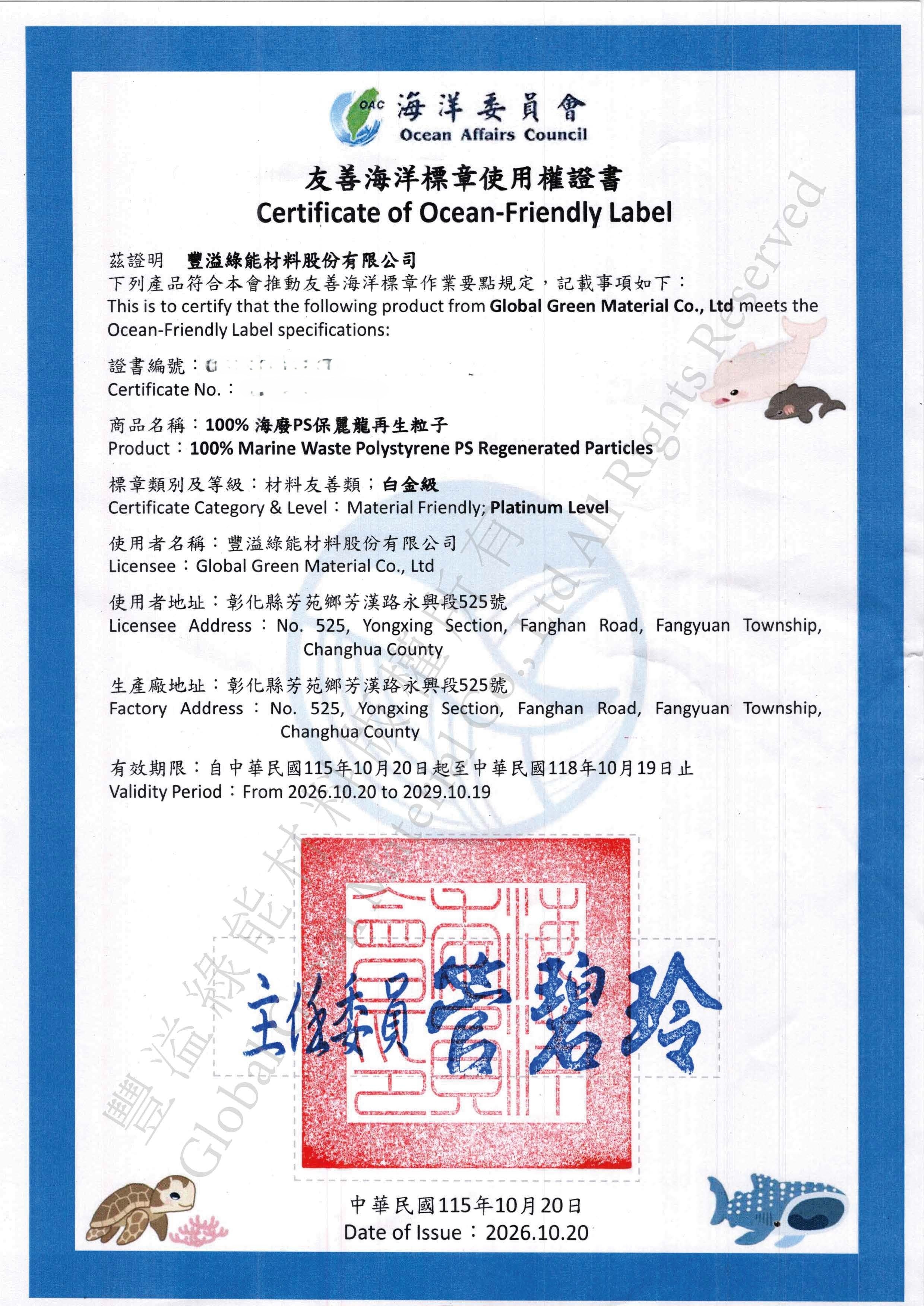
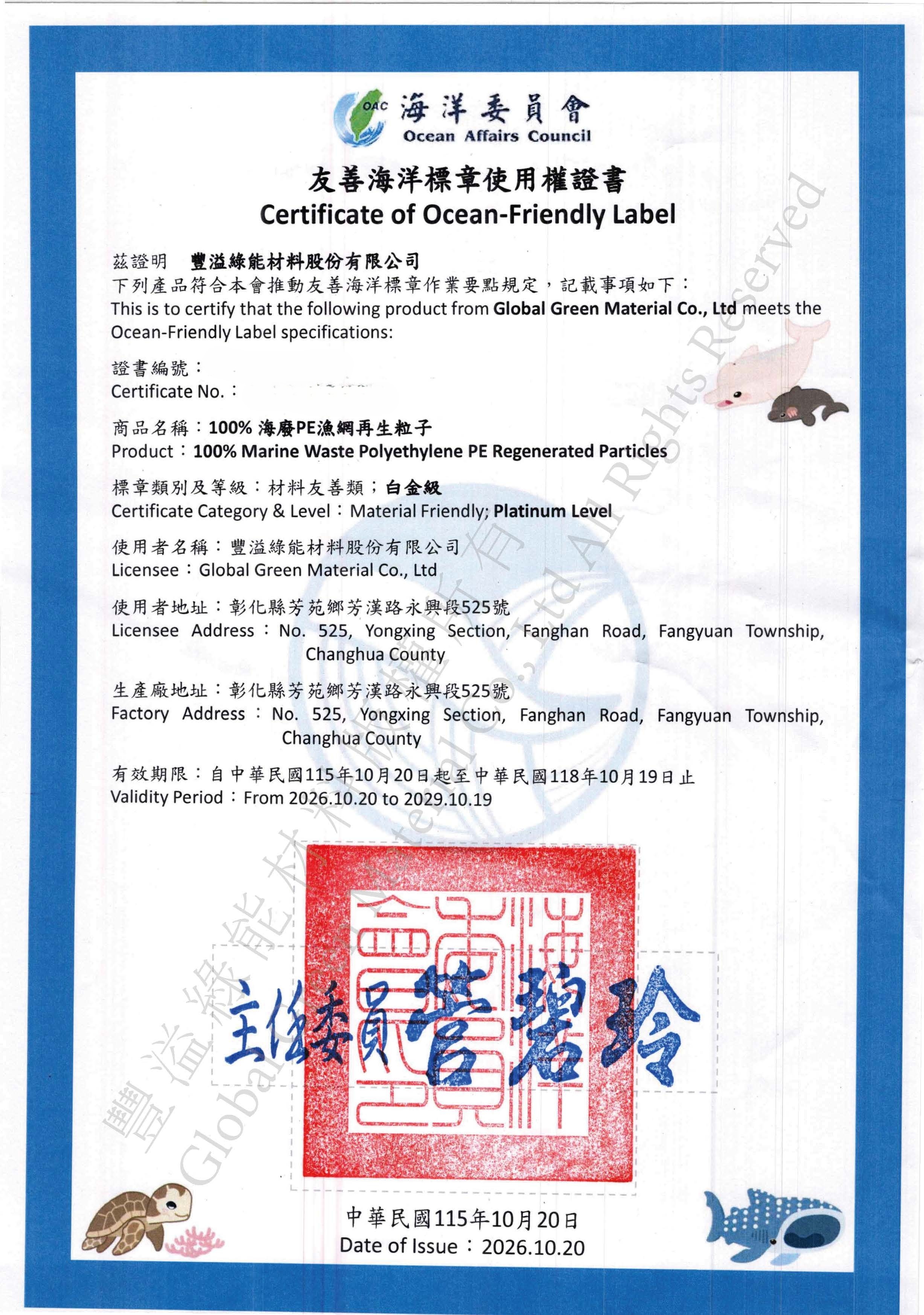
Global Green Material Co., Ltd. is proud to announce that it has received the Ocean-Friendly Label certification from Taiwan’s Ocean Affairs Council, becoming the first company in Taiwan to obtain this label. Two products have been approved under this certification: 100% Ocean Waste Polystyrene (PS) Recycled Pellets, made from discarded marine EPS foam, and 100% Oceane Waste Polyethylene (PE) Recycled Pellets, made from discarded HDPE fishing nets.
Both products have been awarded the Platinum Level under the Material-Friendly category. The certificates are valid from October 20, 2026, through October 19, 2029.
This achievement recognizes Global Green Material’s commitment to marine waste recycling and material innovation. More importantly, it demonstrates our determination to transform marine waste into valuable resources that can re-enter industrial supply chains, creating opportunities for both environmental protection and sustainable business development.
1. Ocean-Friendly Label Certification: Enhancing Transparency and Value in Recycled Marine Materials
To encourage the development and use of recycled materials derived from marine waste, Taiwan’s Ocean Affairs Council has established the Ocean-Friendly Label program. Through its application requirements and review mechanisms, the program helps businesses and consumers identify products that incorporate recycled marine materials and promotes the circular use of marine waste.
Global Green Material has successfully obtained two Ocean-Friendly Label certificates, both at the Platinum Level under the Material-Friendly category. The certified products are explicitly identified as being made from 100% ocean-waste-derived recycled pellets, demonstrating our ongoing commitment to marine waste recovery, processing, and material development.
For us, this certification represents more than a label. It is an important step toward improving material traceability, enhancing transparency, and encouraging sustainable procurement across industries.
We hope that our achievement will inspire more companies to recognize the potential of recycled marine materials and integrate environmental responsibility into their product design and manufacturing processes.
2. Two Key Recycled Marine Materials: PS Foam and HDPE Fishing Nets
2.1 100% Ocean Waste PS Recycled Pellets
Expanded polystyrene (EPS) foam is commonly found among marine debris collected along coastlines, in ports, and from marine environments. Due to its bulky structure, transportation challenges, and potential contamination from salt, barnacles, and other impurities, recycling marine EPS foam requires specialized processing technologies.
Global Green Material has developed patented technologies for EPS foam volume reduction and recovery, together with distillation-based extraction treatment technology. Through material separation and impurity-removal processes, we work to reduce contamination before proceeding with subsequent processing steps, including crushing, filtration, and pelletizing.
These processes transform difficult-to-handle marine EPS foam into recycled PS particles that can serve as raw materials for industrial applications.
Our objective goes beyond collecting and disposing of marine EPS waste. We focus on improving material quality, expanding potential applications, and turning discarded foam into a resource with renewed industrial value.
2.2 100% Ocean Waste PE Recycled Pellets from HDPE Fishing Nets
Discarded fishing nets represent another important challenge in marine waste management. Fishing nets may contain different plastic materials and can be mixed with floats, metal components, salt, and other foreign substances. Proper material identification, sorting, and processing are therefore essential to improving the quality of recycled materials.
Global Green Material uses manual sorting to separate HDPE fishing nets from other materials. The selected materials then undergo washing, shredding, mixing, and multi-stage melt filtration to remove impurities before being pelletized into recycled PE particles.
Through these processes, discarded fishing nets can become valuable raw materials for plastic manufacturing rather than remaining difficult-to-manage waste.
By combining material recovery expertise with recycling and pelletizing technologies, we aim to expand the potential applications of marine-derived plastics and create new opportunities for circular material use.
3. Beyond Recycling and Pelletizing: Customized Material Properties to Meet Customer Needs
At Global Green Material, we understand that adopting recycled marine materials involves more than simply confirming their origin. The materials must also meet the processing requirements, functional performance, and quality expectations of the products in which they will be used.
Different industries and applications have different material requirements. Injection-molded products may require specific levels of melt flow, impact strength, and stiffness, while extrusion and blow-molding applications may place greater emphasis on processing stability, forming performance, and product durability.
If recycled materials cannot meet these requirements, manufacturers may find it difficult to incorporate them into existing production processes, even when their environmental benefits are significant.
That is why Global Green Material offers more than recycled PS and HDPE pellets. Our capabilities also include compounding, material modification, formulation development, and customized material solutions.
Based on customers’ intended applications and processing conditions, we can evaluate and adjust material formulations to address requirements such as melt flow characteristics, stiffness, impact performance, and other processing or end-use properties.
Through formulation development, testing, and validation, we work closely with customers to identify suitable material solutions. The achievable properties and extent of adjustment depend on the characteristics of the marine-derived feedstock, formulation design, and the customer’s specific requirements.
Our goal is not to ask customers to compromise product quality in order to use recycled marine materials. Instead, we leverage material engineering and processing technologies to make these materials easier to integrate into existing manufacturing processes, increasing their practicality and adoption across industries.
From marine waste recovery, sorting, washing, and pelletizing to compounding, material modification, and customized development, Global Green Material strives to provide comprehensive material solutions that help customers turn sustainability goals into practical products.
4. Building a Circular Future for Marine Waste Requires Industry-Wide Collaboration
Ocean waste cannot be effectively addressed through coastal cleanups and waste collection alone. Every stage of the process—from collection and sorting to recycling, material development, product design, and market adoption—requires collaboration among governments, recyclers, material suppliers, brand owners, manufacturers, and consumers.
For manufacturers, adopting recycled marine materials is one way to put circular economy principles into practice. For brands, working with material suppliers to develop products using marine-derived plastics can turn sustainability commitments into tangible outcomes. For consumers, supporting products with transparent material sourcing and appropriate verification can help encourage more companies to invest in marine waste recycling.
Global Green Material looks forward to collaborating with more brands, manufacturers, and industry partners to explore the potential of marine-derived materials from the earliest stages of product development.
Through material testing, formulation adjustments, and process validation, we aim to help businesses overcome the challenges associated with using recycled marine plastics and develop products with both commercial value and environmental benefits.
We believe that when recycled marine materials can be used reliably and adopted through long-term procurement, marine waste recycling can become part of a more sustainable and self-reinforcing circular economy.
5. Join Global Green Material in Turning Marine Waste into New Opportunities
Receiving the Ocean-Friendly Label marks an important milestone in Global Green Material’s ongoing commitment to marine waste recycling and resource recovery. However, this achievement is not the end of our journey.
We will continue investing in marine waste processing technologies, recycled pellet production, material modification, and customized formulation development. Our goal is to help more businesses overcome the challenges of using recycled marine materials and transform discarded marine waste into valuable industrial resources.
We sincerely invite brands, product manufacturers, and industry partners interested in adopting recycled marine materials to work with us. Whether you are exploring applications for PS foam, HDPE fishing nets, or other marine-derived materials, our team is ready to work with you to evaluate possibilities and develop suitable material solutions tailored to your needs.
The value of marine waste should not end with recycling. It should continue through its successful return to the industrial value chain, where it can be used again to create new products.
Together, we can address the marine waste challenge through better material choices, innovative product development, and long-term collaboration. By turning marine conservation into practical industrial action, we can create new opportunities for both environmental sustainability and business growth.
Global Green Material invites you to join us in bringing recycled ocean materials into more products and building a more sustainable future for our oceans.